Description
LE CŒUR DE MICHEL-ANGE
2025, Paris
Somewhere between Rendez-vous, my painting where I had finally painted myself and Adam and Eve on Mars—painting done in two thousand twenty-four—where I was approaching sixty, where my body was tiring, where I was beginning to ask myself questions I had never dared formulate clearly before, serious questions, anguishing, almost tragic about what I was doing, about the meaning of what I was doing, about the very possibility of continuing to create in a world that had perhaps already created everything, that had already reached artistic perfection peaks so high, so inaccessible, so crushing that we, contemporary artists, could only look toward the past with a mixture of admiration, despair, powerlessness, knowing that we would never, never reach these heights, somewhere in those years I decided to paint something I had carried within me forever but had never dared confront directly: my relationship with Michelangelo, with David, with this unattainable perfection that dominated me, crushed me, silently judged me for five hundred years.
David, I had seen it in Florence, when? I no longer remembered exactly, perhaps in two thousand five, two thousand six, I had gone to Florence, I had visited the Galleria dell’Accademia, and I had seen David, and I had stopped, petrified, crushed, almost annihilated by this colossal presence, this absolute perfection, this beauty that was not human, that could not be human, five meters seventeen in height, a marble colossus, a giant, and me so small below, raising my eyes, neck broken to see his face, and I had looked at David raising my eyes, exactly as everyone looked at him, exactly as everyone had to look at him, in a position of almost religious reverence, of submission, of acceptance of our inferiority, of our smallness, of our inability to ever reach this height, this grandeur, this perfection.
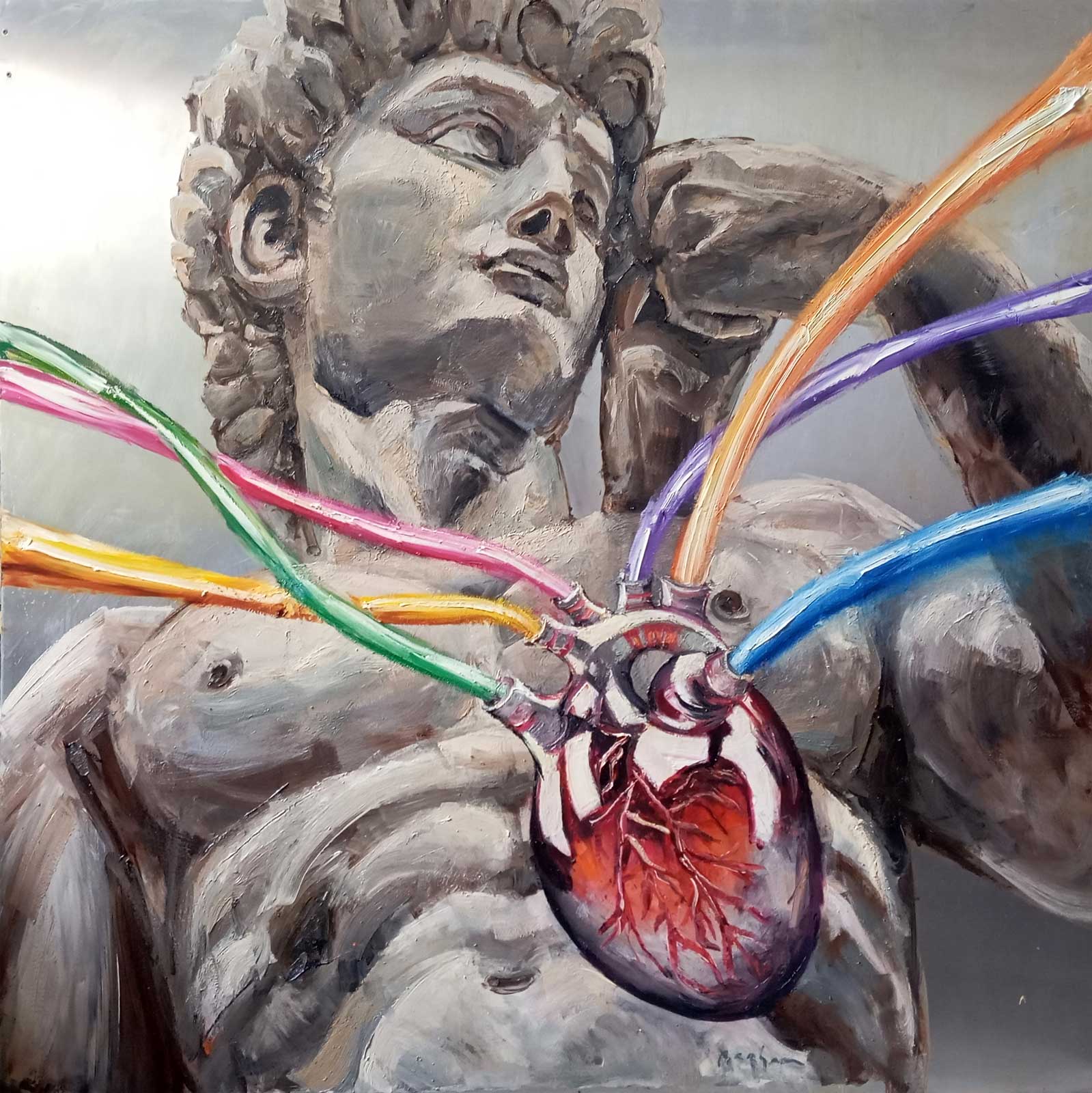
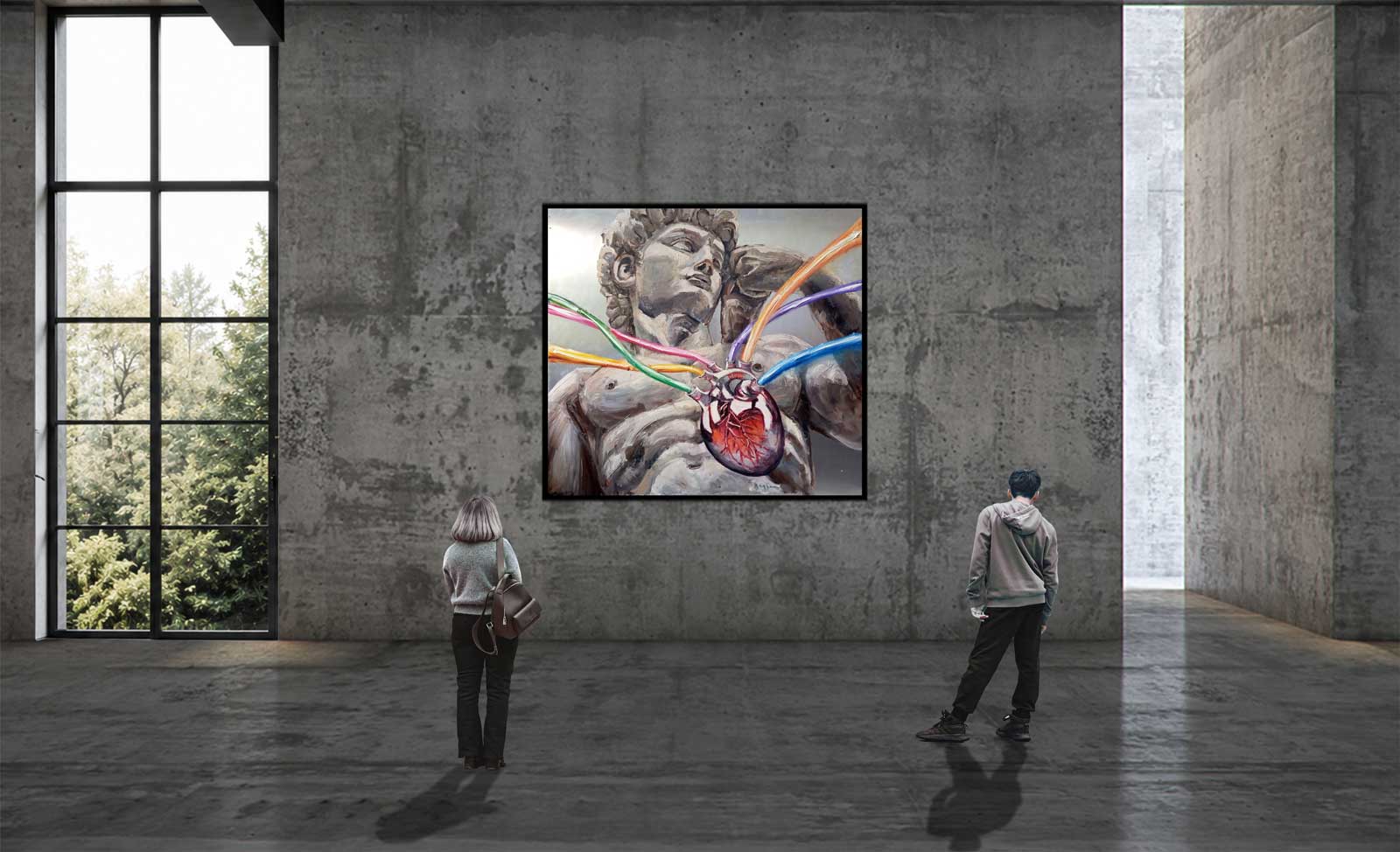
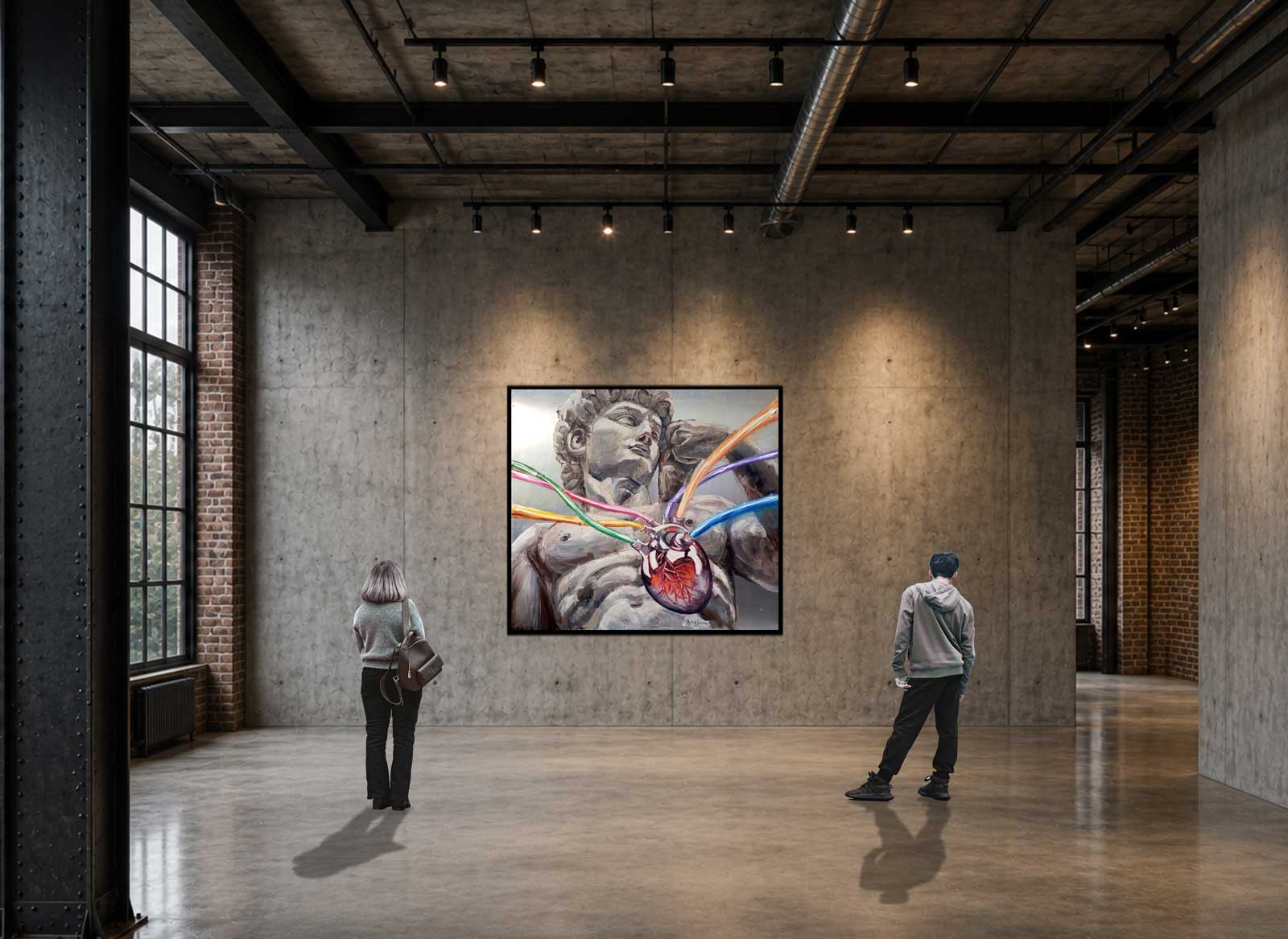
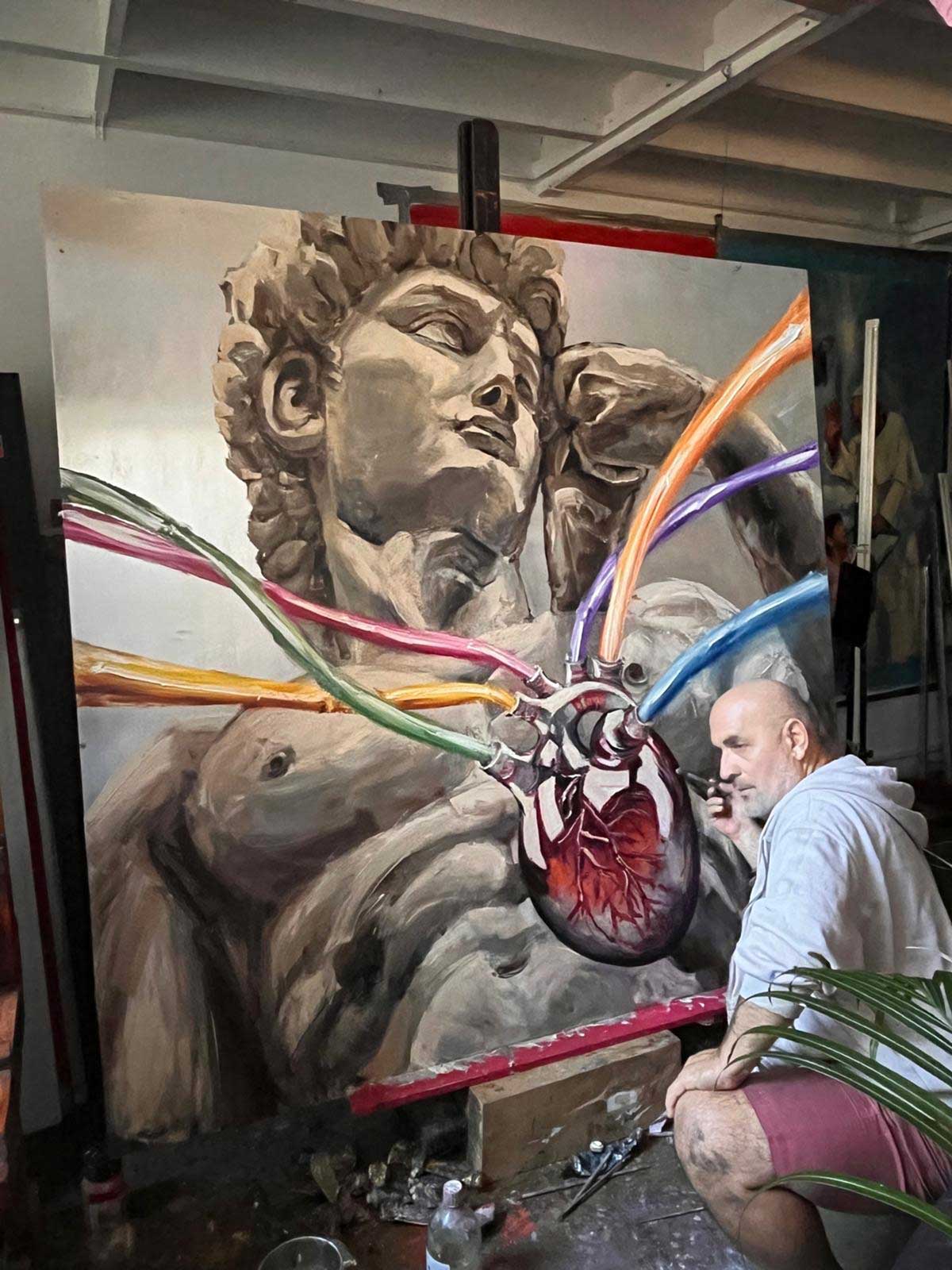
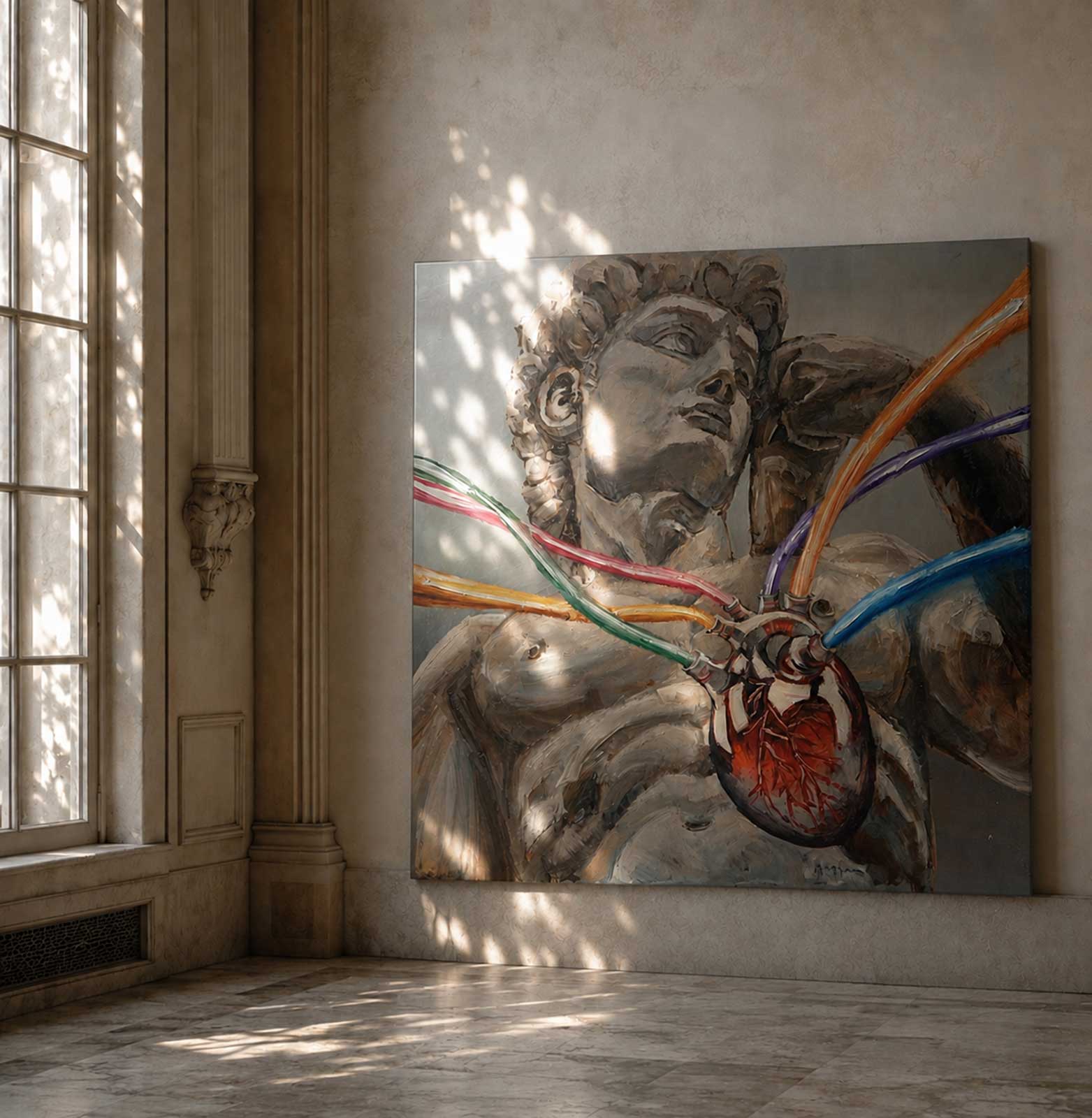
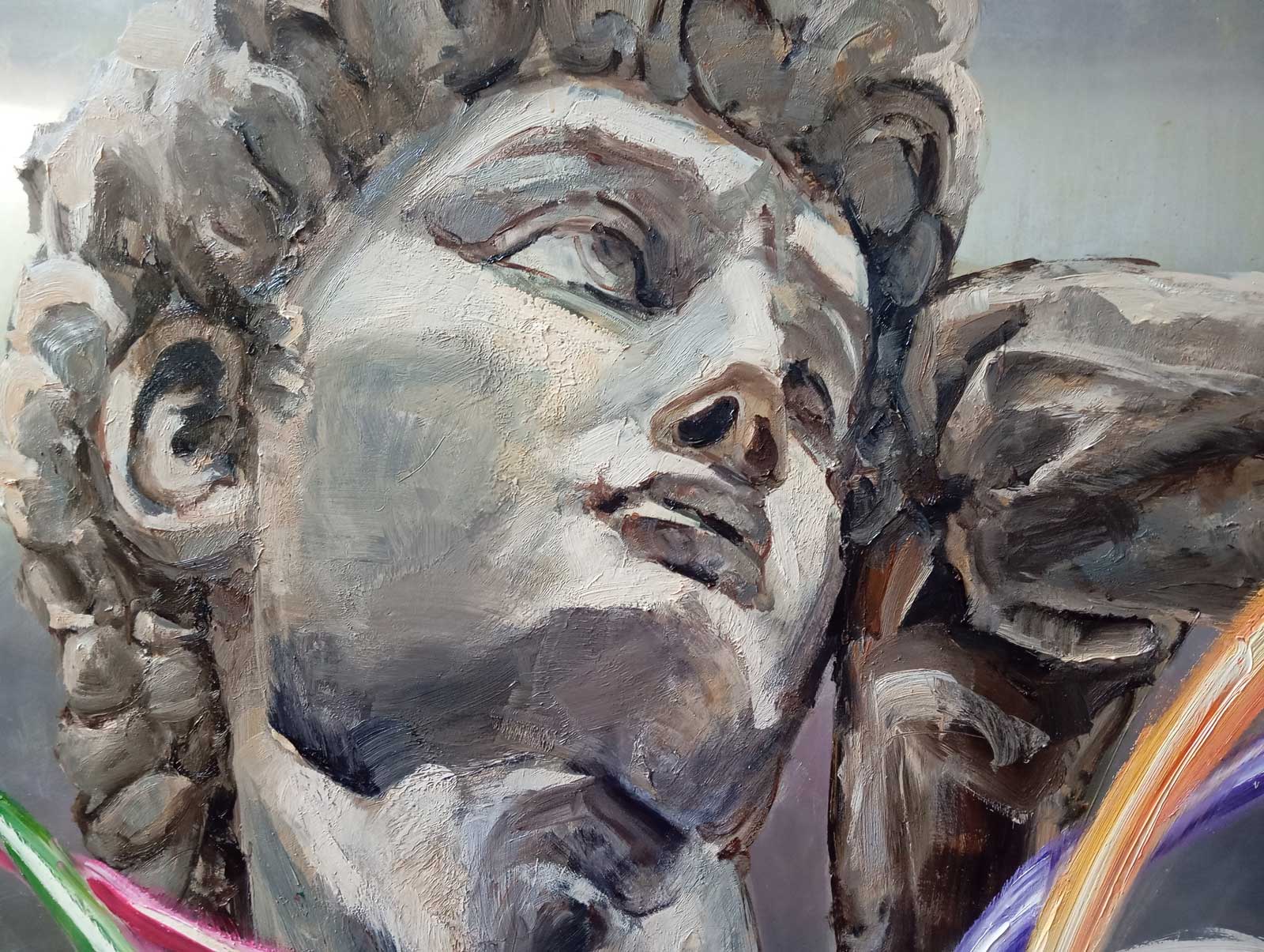
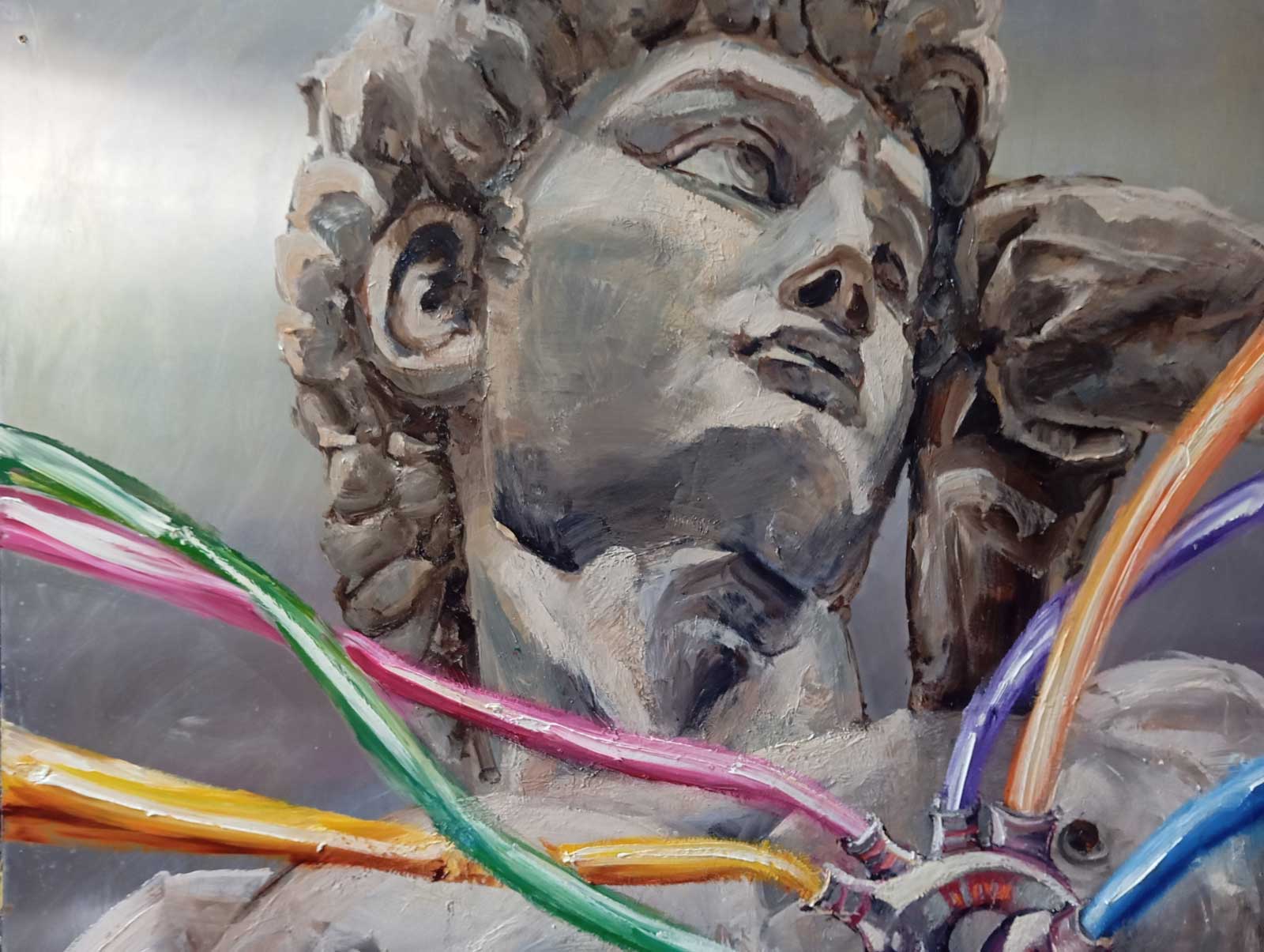
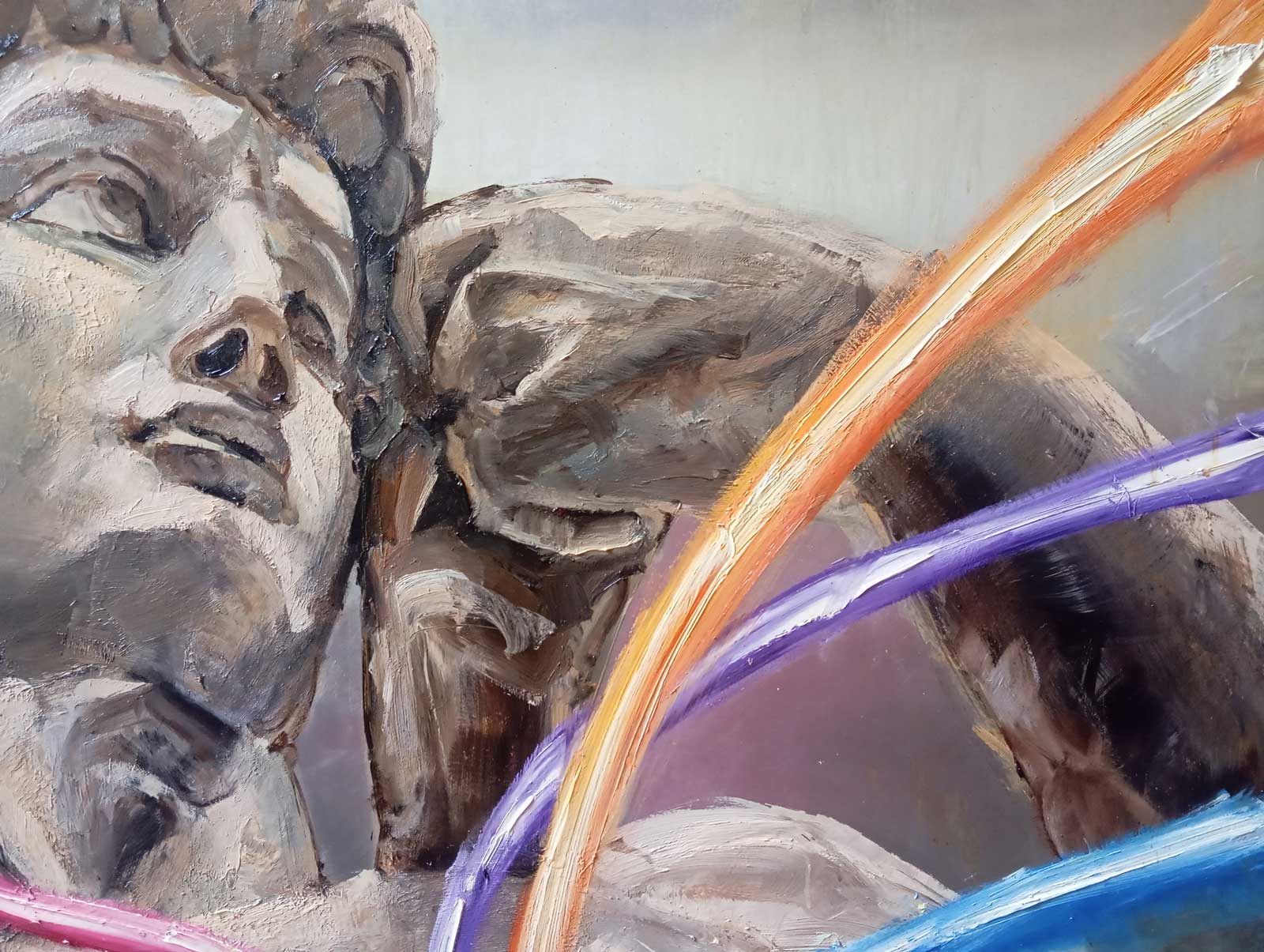
And years later—perhaps fifteen years, perhaps eighteen years after having seen David in Florence—I decided to paint David, not to copy him, not to reproduce him faithfully, no, I wanted to paint my relationship with David, my position facing him, my powerlessness before him, this domination he exercised over me, over all of us, contemporary artists who had to raise our eyes toward him, who were condemned to look at him from below, and to show this domination, this crushing, this terribly unequal power relationship, I painted David exactly as I had seen him: in low angle, seen from below, raising my eyes, David who physically dominates us, who crushes us by his size, who judges us from his height, who embodies unattainable perfection.
I painted him in grisaille, in marble tones, in subtle variations of whites, grays, beiges, to render his materiality, his sculptural presence, his mineral permanence that crossed centuries without changing, without aging, without tiring, his face sculpted with perfect anatomical precision, his curly hair, his gaze that fixed the horizon, Goliath, the enemy, with intense concentration, his naked body, muscled but not excessively, just perfect, ideal, the perfection of human form, absolute balance, and this iconic position, this contrapposto where all weight rests on one leg while the other is relaxed, creating this curve, this frozen movement, this tension in repose, this life in dead marble.
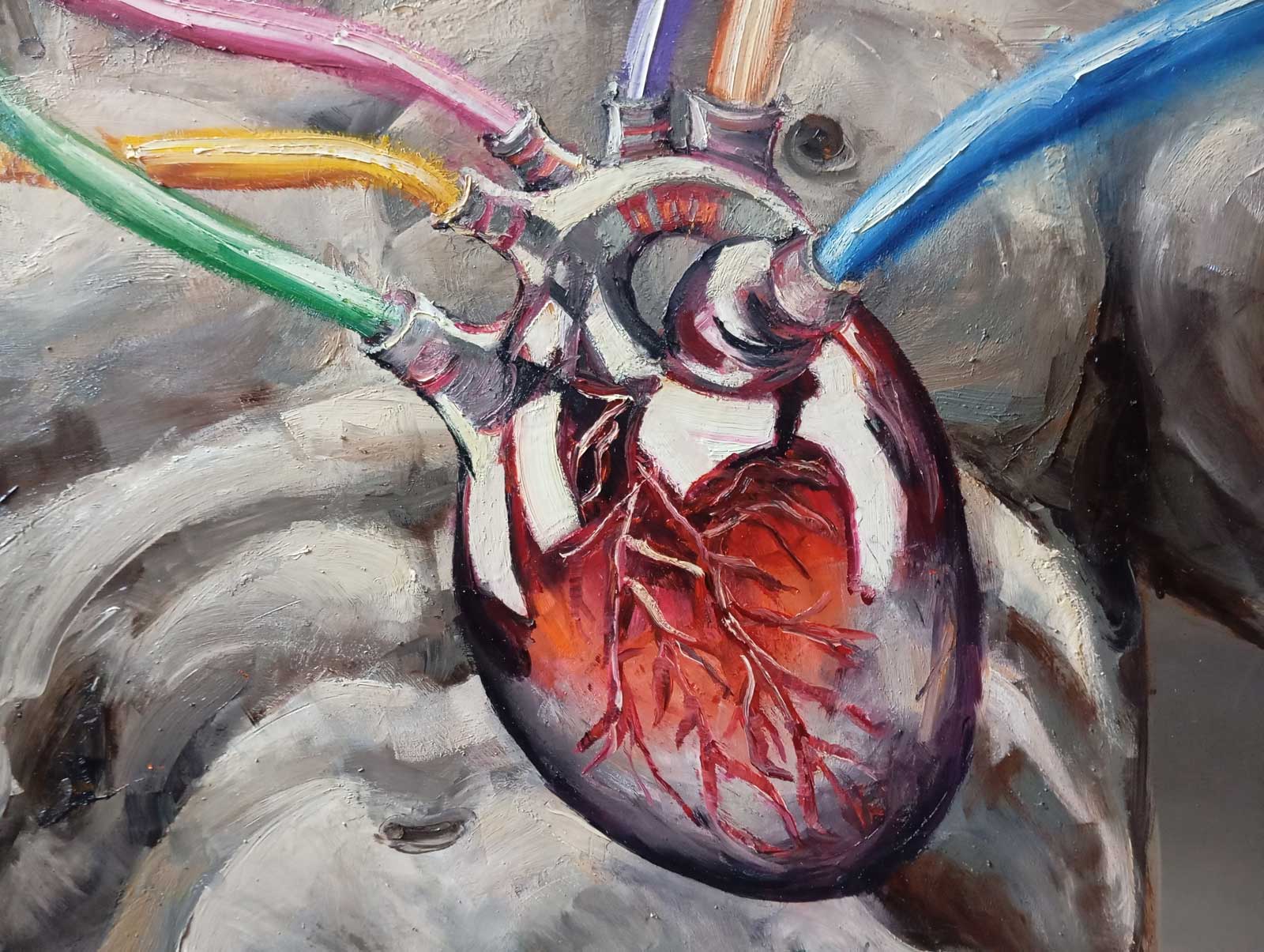
And then, before David, in the foreground of the painting, me, Cornel Barsan, almost sixty years old, seated in my studio rue Ricaut, bent over my work, small, diminished, crushed by the colossal presence of David behind me, and in my hands, a heart, a heart I was holding, that I was looking at, that I was perhaps offering to David, to Michelangelo, to tradition, to art history, saying: « Here, this is all I have, this is all I can offer, a heart, to try to revive tradition, to try to continue culture, to try to keep art alive, take this heart, accept it, » but—and this was the terrible, tragic revelation of the painting—the heart was not a real heart, it was not an organic heart, living, beating, warm, blood red, no, it was a glass heart, a transparent heart, an artificial heart, a prosthesis, a fragile substitute, an imitation, a simulation, a manufactured object that had the form of a heart but not its substance.
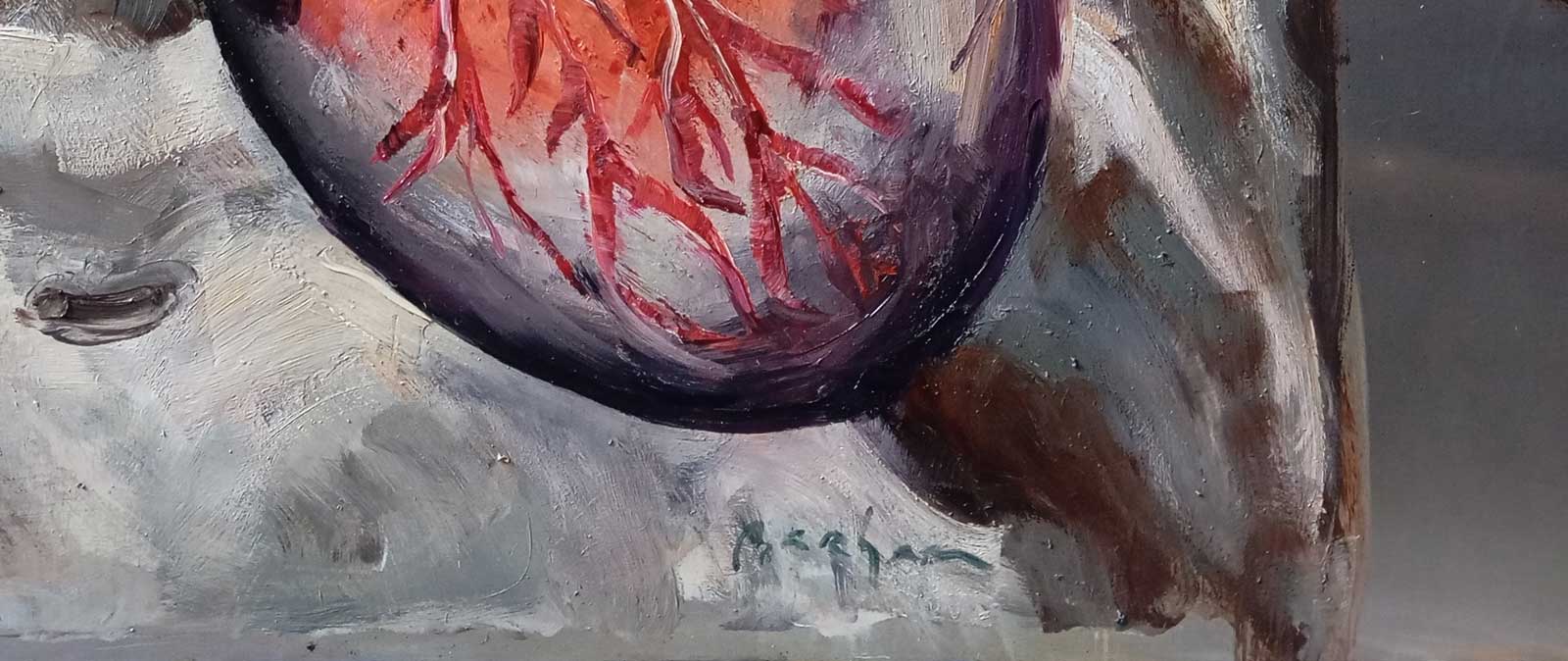
And this glass heart, I had painted it carefully, with precision, showing its transparency, its fragility, its artificiality, the colored glass tubes that came out of it—red, blue, green, orange, purple—like artificial arteries and veins, and the question the painting posed was terrible, anguishing, almost unbearable: can we really revive tradition with a glass heart? can we really continue culture with artificial tools, fragile, precarious? can we really keep art alive when we no longer have the strength, the faith, the capacity to create as Michelangelo created, when we can only offer a fragile substitute, an imitation, in place of true life, true beauty, true perfection?
The glass heart said: « We can no longer give a true living heart to tradition, we have lost this capacity, we can only offer a substitute, an artifice, a fragile prosthesis, and we know it is not enough, we know it will probably break, but this is all we have, this is all we can offer, » and me in the painting, seated before the colossal David who dominated me, holding this glass heart in my hands, perhaps looking at it with a mixture of hope and doubt, of faith and despair, knowing this heart was insufficient but offering it anyway because it was all I had, all I could give after twenty years of efforts, twenty years of obstinate creation.
David looked at me, or rather he did not look at me, he looked above me, beyond me, toward Goliath, toward the horizon, toward eternity, indifferent to my insignificant presence, to my derisory offering, to my glass heart that did not interest him, that could do nothing for him because he did not need it, because he was already perfect, already eternal, already immortal, and nothing that I, Cornel Barsan, invisible artist of the twenty-first century, could offer him would change anything about his perfection, his grandeur, his eternal domination.
In painting Michelangelo’s Heart—probably in two thousand twenty-four—I understood something fundamental: I had spent my whole life trying to create something that would last, that would cross time, that would survive me, exactly as Michelangelo had created David which had crossed five hundred years, but the difference—the terrible, cruel, unjust difference—was that Michelangelo had created with a true living heart, he had had genius, he had had technique, he had had absolute faith, he had had society’s support, and me? me I was trying to create with a glass heart, I had perhaps a little talent but certainly not genius, I had correct technique but not absolute mastery, I had faith but a fragile faith, precarious, and I lived in an era where art had become marginal, secondary.
So yes, the heart I offered to David, to Michelangelo, to tradition, was a glass heart, transparent, fragile, artificial, because that was all I had, because I could not offer better, and I held it toward the colossal David saying « here, this is all I have, it is insufficient I know, but this is all I can offer, » and perhaps—perhaps—that was still something, perhaps this glass heart was still worth something, not as much as a true living heart obviously, not as much as Michelangelo’s genius obviously, but something anyway, the attempt, the effort, the obstinacy, the faith maintained despite everything, the refusal to completely abandon, the affirmation that even with a glass heart, even with diminished means, we could still create, continue, transmit something.
Michelangelo’s Heart. The colossal David dominating me. Me small below, holding my transparent glass heart, fragile. The serious question: can we revive tradition with a glass heart? The uncertain answer, painful: perhaps not, probably not, but we try anyway, because we have no choice, because that is our vocation, David looked at the horizon, my glass heart remained in my hands, the question remained suspended, without answer, perhaps without possible answer, and I returned to my studio, I continued to paint, with my glass heart, with my fragile faith, with my incomprehensible obstinacy, under the eternal gaze, crushing, of the masters of the past who dominated me, judged me, found me insufficient but whom I refused anyway to abandon.
Michelangelo’s Heart. The question without answer. The derisory offering. The fragile faith. The tragic obstinacy. The glass heart, transparent, fragile, artificial, insufficient, but offered anyway, held toward the colossal David, toward eternal Michelangelo, saying « here, this is all I have, take it, or reject it, we offer it anyway, » David looked at the horizon, my glass heart remained in my hands, tradition continued, or ended, we didn’t know, we just continued, with what we had, our glass hearts, our fragile faiths, our incomprehensible obstinacies, to the very end, always.